
Where did you get the driver from? I didn't do anything. Or is it a Kayeton camera?
557 2020-08-13 19:44:16
Re: Kinovea 0.9.3 (beta) (42 replies, posted in General)
Also double check the framerate received by Kinovea is the one you expect. You can see this in the infobar above the capture screen. The "Signal" value should be near the framerate you expect. If it's around half what you expect you will get a sped up video as you describe. If you are in low light conditions for example the camera can decide to increase exposure time and lower the framerate automatically, disregarding the configuration.
558 2020-08-12 11:04:28
Re: Keyboard shortcut for Preferences... and other features (4 replies, posted in General)
hhsospam wrote:
2) if there could be an additional keyboard shortcut for different increment amount such as IncreaseDelayby1 with Shift+Up in the CaptureScreen (in addition to the current 0.1 increment) similar to the IncreaseSpeed1, IncreaseSpeedRoundTo10 in the PlayerScreen, that would be very helpful.
Yes, good point. In order to make it homogeneous with the playback side I'm thinking of the following:
- Up/Down = increase/decrease to the next whole second. (That's also the granularity of the arrows on the numeric input control).
- Shift+Up/Down = increase/decrease to the next 0.5 second.
- Ctrl+Up/Down = increase/decrease by one frame.
Another thing to note is that when you pause the stream the delay slider can act as a sort of position slider like the main position slider in the playback screen, at some point I would like to maybe replace the delay slider control by the full one. In the meantime I think it will be interesting to have the same shortcuts to move around in the sequence, so home/end to move to the start/end, page up/down to move by 10%, left/right arrow to move frame by frame.
559 2020-08-10 22:18:54
Re: Kinovea 0.9.3 (beta) (42 replies, posted in General)
Reposting my comments here
If you run the executable again the name will be generated based on the order of launch. So the second instance will have name "2", the third will be named "3", etc. This means you will need to launch them in the same order.
There seems to be a bug in this feature that the numbered instances are picking the master preference file and not their respective preferences. So for now please use explicit naming. A simple way to do that is to right click the executable, create a shortcut, and then go in the properties of the shortcut and in the "Target" field add "-name foobar" at the end. Then to launch that instance you use the shortcut.
If you have a single camera in each instance, it will only use the "left" naming scheme.
Edit: I fixed the issue with the instance using the wrong preferences when it's named automatically from its order in the launch sequence. This will be fixed in the next version, in the meantime please use explicit names.
560 2020-08-10 15:05:51
Re: Kinovea 0.9.3 (beta) (42 replies, posted in General)
Maybe try to tweak the audio threshold so that it only triggers when you want. For example locate the microphone close to the impact area and set it to only trigger when it's really loud. You can test this directly in the preferences dialog.
At the moment there is no "cool down" period where the trigger would be disarmed for a while after recording, hopefully I can integrate this for the next version.
561 2020-08-09 10:22:07
Re: Keyboard shortcut for Preferences... and other features (4 replies, posted in General)
Hi,
1. Invoking Options->Preference via a keyboard shortcut: at the moment, no. Menu shortcuts work a bit differently. This could be added relatively easily but it won't be user-definable. Note that the other keyboard shortcuts listed in the preferences are customizable, you need to place the cursor in the text box in the lower left and type the key you want then apply.
2. Saving/restoring screen layouts. There is a work in progress on the concept of "workspaces" but the camera side is not implemented yet. There is a complication from the way the cameras are discovered dynamically.
Saving and restoring camera-specific parameters (image size, framerate, etc.) should work out of the box. This is saved in the preferences XML file and should work for instances installed in different folders or for instances launched from the same folder but with different "names".
The capture delay is not saved anywhere at the moment.
3. Yeah, this is problematic. I think there are 3 ways to go about it. First is a cooling-down period configurable from the settings, preventing any trigger for a period of time after a capture. This wouldn't really help with the scenario you described though. Second is an "arming" or enable/disable button in each capture screen. The third option is a single button (maybe in the explorer panel on the left) or a menu that would work globally for all screens (but not across instances).
3a. and 3b. You can change playback speed and camera delay with the UP/DOWN arrow keys.
3c. You can start/stop the camera stream with SPACE shortcut.
I'll note down the issue with sleep. Maybe there is a way to be notified when the computer is about to go to sleep and take some preventive measures like that.
4. Starting Kinovea using a specific "Open replay folder observer". Yes this is possible in the current state of the workspaces feature. I'll post it here but to anyone reading this in the future, please be aware that the format may change.
So there is a concept of workspaces, the end goal is that you could take your current layout of screens and save this to a file and reload it later. At the moment you have to create and edit the workspace file manually.
Here is an example file that will create a single folder observer on the "D:\temp\left" directory:
<?xml version="1.0" encoding="utf-8"?>
<KinoveaWorkspace>
  <FormatVersion>1.0</FormatVersion>
  <Name>Single replay</Name>
  <Id>3f19d841-66b5-4853-87ce-a0ec35ccc7a7</Id>
  <ScreenDescriptionPlayback>
    <FullPath>D:\temp\left\*</FullPath>
    <Autoplay>true</Autoplay>
    <SpeedPercentage>100</SpeedPercentage>
    <Stretch>true</Stretch>
    <IsReplayWatcher>true</IsReplayWatcher>
  </ScreenDescriptionPlayback>
</KinoveaWorkspace>
Save this to a text file and rename it with a .xml extension.
In order to launch Kinovea with this workspace you can pass the file path directly on the command line, or use the -workspace option:
Kinovea.exe workspace.xml
Kinovea.exe -workspace workspace.xml
(The first variant means that just dragging the xml file on top of Kinovea .exe will also work).
If you want a dual playback screen setup you can add another `ScreenDescriptionPlayback` node. For a normal playback screen you point the exact file and `IsReplayWatcher` must be set to false. For a replay observer you point the directory and use the "*" wildcard instead of the file name. The `Name` and `Id` fields aren't really used at the moment, they will be used to differentiate between multiple workspace files.
Let me know if you find any issues with this feature.
562 2020-08-07 10:37:03
Re: Basler USB3 and other USB2 cameras (20 replies, posted in Cameras and hardware)
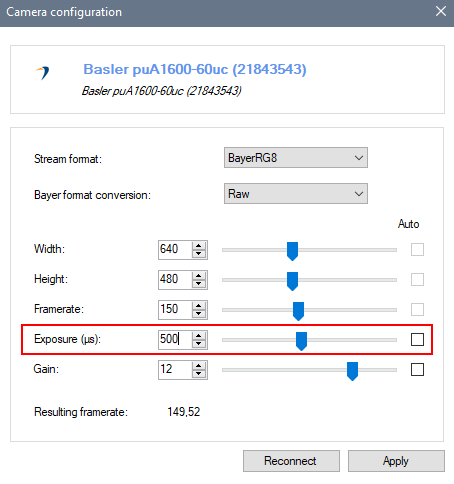
The concept of shutter speed is called "Exposure" in the interface, it's the same thing. It's the duration the shutter stays open while the sensor is being exposed. You can get it from the camera settings (clicking the wrench or clicking the name of the camera at the top). You should get something like this:
563 2020-08-01 13:58:08
Re: Showing distance in "linear Kinematics", not single points? (13 replies, posted in Bug reports)
OK, thanks. Yes when you use line calibration the line becomes the X axis of the coordinate system. This is new in the latest version. I have just recently added code so that you can now choose to assign the vertical axis to the line instead, or ignore the line direction altogether and use a coordinate system aligned with image axes as it was in previous versions. There are still two issues to address though, what to do when the line is tracked, the coordinate system origin is tracked, or both, and fix the displacement values in the kinematics dialog.
564 2020-08-01 10:00:31
Re: Showing distance in "linear Kinematics", not single points? (13 replies, posted in Bug reports)
Is it a vertical video? If you go to menu Image > Rotation does it say that it's rotated 90° already?
565 2020-07-31 09:52:21
Re: 1) Controlling Akaso V50X Action Camera 2)Beta version issues (1 replies, posted in Cameras and hardware)
Typically these action cameras don't have streaming capabilities of the full resolution/framerate. How are you connecting it to the PC? Generally the WiFi link can be used to start/stop recording and control some settings, sometimes to get a low-res preview, but not stream the full live video live. I'm actually surprised you can even get a 30 fps feed. Or are you going through the HDMI output?
Regarding the beta version, do you see the thumbnail of the camera in the camera panel? You need to switch to the camera tab first in the explorer on the left-hand side.
566 2020-07-30 09:56:05
Re: Showing distance in "linear Kinematics", not single points? (13 replies, posted in Bug reports)
Thanks :-)
I think you're right, the total displacement doesn't take into account the moving origin. I'll make more experiments.
Edit: OK there is definitely a bad interference between the coordinate system and the calibration line that follows from recent changes.
567 2020-07-30 09:40:53
Re: Showing distance in "linear Kinematics", not single points? (13 replies, posted in Bug reports)
When you calibrate a line it will redefine the origin of the coordinate system to the start point of that line, maybe that's the trouble? You can move the origin away from the line by dragging the axes but if the line itself is tracked this might interfere. I haven't tested tracking both the calibration line and the coordinate system origin, this probably won't work well. It's possible there is a bug between the interaction of the coordinate system and the calibration line because this was changed recently.
The calibration stays in memory and is saved in the KVA file. If you make a new one it should overwrite it. At the moment you can't really reset to the uncalibrated state (short of editing the KVA file manually), this would be nice to have though!
There is a bug that was fixed recently but is not fixed in 0.9.3, is that the Linear kinematics dialog will show values in pixels instead of the calibrated unit, until some internal flag is triggered somewhere else. The easiest way to work around this is to go to the preferences and save them without changing anything and it should make the values display in the calibrated unit.
You can also right click a point and do "Display measurement" to show the coordinates directly on the screen, it should be easier for experimenting.
568 2020-07-29 23:09:50
Re: Showing distance in "linear Kinematics", not single points? (13 replies, posted in Bug reports)
Yes that's it, the measurements of the second point will be relative to the first.
Thanks for reporting that the coordinate system point is itself visible in the Linear Kinematics graphs, it doesn't really make sense to show it here since it's always zero by definition, I'll note to remove it for future versions.
569 2020-07-29 21:54:47
Re: Showing distance in "linear Kinematics", not single points? (13 replies, posted in Bug reports)
Maybe one way to do what you are looking for would be to have one tracked point be the origin of the coordinate system, and the other being a regular trajectory or tracked point.
You can show the coordinate system from menu Tools > Coordinate system, it is trackable. Normally if you track the coordinate system itself the other tracked points will be expressed in the moving coordinate system.
570 2020-07-28 21:15:13
Re: Basler USB3 and other USB2 cameras (20 replies, posted in Cameras and hardware)
Regarding flickering, assuming it's coming from the mains AC frequency at 50Hz or 60Hz, can you guys try to set the camera framerate to a multiple of this to see if it improves the situation? Although I imagine you'll have 1/2 chance of synchronizing to the dark part of the flicker.