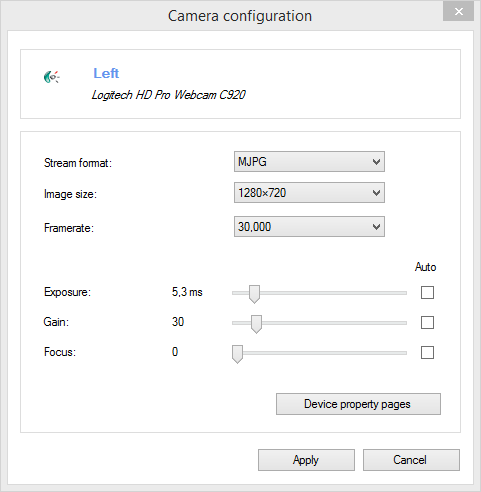
I spent a few hours on a computer with two Logitech C920 today.

I'm actually surprised you got this far :-)
On the system I tested the highest resolution available was 640x480 and the two cameras couldn't be active simultaneously, only one or the other.

This camera seems to be the current best-seller so I might buy one myself to make more tests and see if its support in Kinovea can be improved.

From what I can gather the higher resolutions are coming down a different channel. There is on-camera compression to H.264 (USB 2.0 bandwidth is about 35 MB/s which is not enough to transmit raw HD frames at 30 fps). Some softwares like Skype must be able to directly consume this H.264 stream. Whereas other softwares handle frames that have been uncompressed by some other underlying component.

887

(2 replies, posted in Ideas and feature requests)

I'll probably show my utter incompetence in Apple devices, but can you plug it in USB storage mode? When I use this option on an Android device I can browse the content from Kinovea file explorer.
Do you use a special software to copy the files or just Windows Explorer ?

Hi,
The F5 shortcut key is bound to this functionality. As in Windows Explorer or Web browsers.

889

(1 replies, posted in Français)

Version expérimentale, merci de remonter toutes les regressions éventuelles !

Installeur : Kinovea.Setup.0.8.23.exe
Version portable : Kinovea.Portable.0.8.23.exe

Le topic annonce sur le forum anglais avec tous les détails!

890

(2 replies, posted in General)

Experimental version. As always feedback is very appreciated! wink
Beware of regressions and report anything suspicious. Do not assume the issue is known.

Installer: Kinovea.Setup.0.8.23.exe
Portable version: Kinovea.Portable.0.8.23.exe

There are four important aspects to 0.8.23:

  1. A new "portable" version.

  2. Lens distortion correction.

  3. Kinematics plot for trajectories and scatter plot for markers.

  4. Polyline, arrows, and styling improvements.


1. Portable version
The portable version is an autonomous Kinovea that doesn't need to be installed in "Program Files".

When you double click the downloaded executable it will extract itself in a sub-directory of the current directory. You can then copy that new directory wherever you want, on a USB stick for example. To run, locate and start "Kinovea.exe" inside this directory.

This is nice for testing new releases or to carry Kinovea in your pocket.
It uses its own local preferences so you can run it in parallel to the installed ones without interferences.

2. Lens distortion correction
This new feature lets you calibrate your camera's lens distortion. Kinovea will then take that distortion into account for all coordinates and measurements.
This allows the processing of videos filmed with GoPro cameras for example.

There are more information on this feature in this topic, and I'll post a tutorial on how to perform the calibration on the blog in a few days.
http://www.kinovea.org/screencaps/0.8.x/lensdistortion/distortedsquash.jpg


3. Data analysis
A new "Data analysis" menu is available from the trajectory and the point/marker drawing context menus.
This opens a dialog window with plots and data export utilities.

For the Trajectory tool, it creates a time-series plot of a kinematic quantity (position, total distance, velocities, accelerations, etc.) You can change the plot from the "Data source" combo box in the upper right corner. The about tab explains the data filtering algorithms used.
http://www.kinovea.org/screencaps/0.8.x/dataanalysis/dataanalysis-traj.jpg

For the marker tool, it creates a scatter plot of all markers added in the video.
Combined with plane calibration, this can be used to map ball impacts, player locations, etc.
Here is a short tennis point with mapped ball impacts.
http://www.kinovea.org/screencaps/0.8.x/dataanalysis/dataanalysis-points.jpg

Both these windows have export options on the right. The save to file option will save a .csv file that you can open back in a spreadsheet application.

You will notice that the values exported do not exactly match the ones exported by the "File > Export to spreadsheet" menu. The latter do not use any filtering and are subject to noise. If you do not intend to perform your own filtering, you should always use the export function from within the data analysis windows.

4. Polyline, arrows and color profiles

Several changes related to drawing tools have also been introduced:

  • Some of the tools that were under the "custom tools" button have been relocated to more appropriate places.

  • The custom tools can now be individually styled from the color profile dialog.

  • The new polyline tool lets you draw a series of connected segments.

  • Several variations of arrow tools are now available under the arrow button.

http://www.kinovea.org/screencaps/0.8.x/arrows.png

The raw changelog is here.

Enjoy!

Yes I'll definitely come back to you for testing help, thanks.

The issue with the capture side of things is that there is many different hardware and I can't test most of them.

I am starting to redesign the capture pipeline to integrate benchmarking capabilities and find where the bottlenecks are. At the moment I am just at the "measurability" stage. Trying to take every detail in account.

I want to answer things like:
- What is the the actual grabbing framerate ?
- Is it stable or does it varies widely ? What is its standard deviation ? Median ? 95th percentile ?
- What is the sustainable recording framerate ?
- What is the sustainable display framerate ?
- Does it matter if delayed-display is active ? How large should the buffers be ?
- Should we degrade the display framerate while recording, by how much ?
- What is the best tradeoff between compressing the images (takes CPU time) and not compressing (takes I/O bandwidth) for the current capture configuration ?
- What is the fastest method to write sequential data to the disk ?
- Are the bottlenecks the same between an HDD and an SSD ?
- etc.

I am considering the option of storing captured images to a dedicated format, optimized for fast writing, rather than going through a classic video format as is done currently.
I have a monochrome Basler camera capable of 2048x1084 @ 50fps. Uncompressed, this is about 106 MB/s. The goal is to fully support that kind of bandwidth, and then up from there.

893

(13 replies, posted in Cameras and hardware)

Thanks for the detailed error message.
I have installed the FlyCapture SDK with the DirectShow filter but unfortunately without an actual device I can't test or reproduce.

From what I understand there are two possibilities:

1. The Point Grey DirectShow filter does not implement the IAMStreamConfig interface (to configure camera image size), as it is not mandatory, but Kinovea or AForge requires it while the other software you tested it with does not.
2. The DirectShow filter does implement the interface but there is a mismatch in threading model that make it impossible for Kinovea or AForge to retrieve it.

I would be interested to know how it behaves in a barebone AForge-based application outside of Kinovea context, to see where the problem lies.
You can download the SimplePlayer and the SnapshotMaker applications from here : http://www.aforgenet.com/framework/samples/video.html

Does it work in these applications?
In the SnapshotMaker, can you change video resolution?
What program does it work in?

894

(13 replies, posted in Cameras and hardware)

Hi,
Have you tried what is outlined in this article : http://www.ptgrey.com/support/kb/index. … &q=310
If you have a 64bit system it may very well be the issue, as Kinovea is a 32bit application.

Ha, ça tombe bien que tu remontes ce sujet car il y a du nouveau dans la version à venir 0.8.23.

Deux nouvelles fenêtres d'analyse de données sont disponibles, une pour l'analyse de trajectoires et l'autre pour l'analyse de nuages de points, pour répondre au besoin exprimé dans ce topic. (en attendant une troisième pour les angles, mais plus tard).

On arrive sur la fenêtre en faisant "clic droit > Analyse de données" sur un des points ajouté (outil « marqueur »).
J'ai repris la vidéo de l'échange de tennis de l'exemple précédent, ça donne ça :

http://www.kinovea.org/screencaps/0.8.x/dataanalysis/dataanalysis-points.jpg

Le rectangle bleu pâle correspond au plan de perspective ayant servi à la calibration, ici c'est l'aire du terrain de tennis en lui-même (quatre coins bien visibles, dimensions connues). Les coordonnées brutes des points peuvent être exportées dans un fichier (format CSV) ou dans le presse-papier. Le graph en lui même peut également être exporté.

896

(10 replies, posted in General)

dekigr wrote:

Hi Joan,

just a simple question. When the new version 0.8.23 will be available?

Best regards from
Dejan

Hi,
I sent you a mail a few days ago to help test a pre-version. So, I would say the answer is in your hands :-) Let me know if you have changed e-mail.

897

(2 replies, posted in General)

You can get to the list of shortcuts from menu Options > Preferences… > Keyboard.
However it is very much tied to the user interface, it would be quite contrived to pull it off this way.

What would be required is a more generic triggering mechanism to start and stop recording, with various "sources" for the trigger. Sources might be a keyboard shortcut, a timer firing, an audio threshold, a TCP packet, etc.

898

(10 replies, posted in General)

For the record I have just posted a question on User Experience stack exchange regarding polyline tools. The polyline tool will be the underlying tool for curved lines and arrows.

899

(10 replies, posted in General)

dekigr wrote:

it is nace to hear about new version. Do you add some more graphic elements?

Thanks for the heads up, I'll look into adding arrow tools this week.

900

(10 replies, posted in General)

Hi,
I think both issues are addressed in the next version 0.8.23.
It has been ready for quite a while to be honest, I was waiting for more feedback.

The changes related to your comment:
- there is now an embedded plot window,
- the time values for it are in milliseconds so its always numeric,
- other values have three decimal places,
- you can export the graph or the raw data to a file or copy it to the clipboard.
- The data is exported as .csv for maximum compatibility.