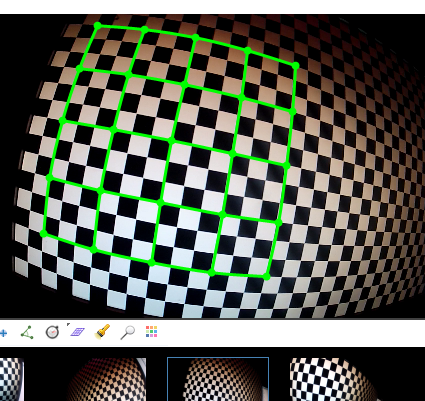
Another possibility is that the frames are sent by the camera as individual snapshots rather than a continuous video stream. As I understand that is the common way of doing things for cameras with external trigger capability.

At the moment this is not supported in Kinovea but it might not be very hard to implement as it is supported in AForge.NET, the library used to communicate with the DirectShow layer.

Hi,
If I understand correctly from your post and e-mail, you disable acquisition frame rate from the Basler configuration dialog accessed from the Properties button so the video doesn't really have a fixed frame rate. Instead the images just come in at variable intervals depending on the external trigger. This disabling is not honored correctly by Kinovea, which forces a fixed frame rate.

Kinovea doesn't really interact with  the device properties dialog, it's just displayed when you click properties. Whatever happens there is not reported back to Kinovea in any way.

Kinovea will indeed try to automatically select a frame rate, which is interfering with your goal I guess.
What I'm not quite sure I undertand perfectly is how you go from the single images grabbed from the Basler down to the AVI video: are you using Kinovea to capture single snapshots and then another program to consolidate them in an AVI, or directly using the recording function ?

Anyway, I'll try to see if the selection of the framerate can be disabled entirely… I'm not quite sure if DirectShow allows this.

978

(4 replies, posted in Français)

Pas sûr d'avoir tout compris… Quand on enregistre et que le différé est de 10s par ex., on enregistre l'action avec 10s de retard (on enregistre ce qui passe à l'écran, pas ce qui est filmé en temps réel). Mais s'ils s'observent (en différé) puis décident de s'enregistrer ou non, ils doivent mettre encore plus de différé (20s) pour rembobiner à nouveau et enregistrer, c'est ce qui se passe ?

Effectivement il faudrait des scénarios d'enregistrement de type pré/post déclenchement. On spécifierait la durée avant, la durée après, et en un seul clic on lancerait l'enregistrement correspondant. Ça reste encore à spécifier clairement en termes d'interface et d'architecture, ce n'est pas prévu pour la prochaine version.

979

(4 replies, posted in Français)

Bonjour,
Le module de capture va être en grande partie réécrit pour la prochaine version (si vous avez d'autres remarques c'est le moment !).

Pour le choix de la caméra, j'essaie de reprendre la même interface que pour les vidéos : la liste des caméras serait directement visible sous forme de vignettes dans l'explorateur, et pour lancer directement la bonne caméra il suffirait de double cliquer dessus ou de faire un glisser-déposer depuis la liste à gauche.

Quelque chose comme ça :
(Normalement on voit quelque chose sur les vignettes mais là il fait nuit tongue)

http://www.kinovea.org/screencaps/0.8.x/explorercamera.png

980

(6 replies, posted in General)

Hi,
Some complications I hadn't considered.
As you might know, Kinovea builds upon third party open source libraries for various aspects. To create a pure .NET 4.0 build, I need to have all these references in pure .NET 4.0 as well.

At the moment, this means : AForge.NET, EmguCV, ExpTreeLib, SharpZipLib, log4net and SharpVectorGraphics.
As far as I am aware, none of these projects have ready made pure .NET 4.0 builds.
They all share source code of course, so I could rebuild them myself to be pure 4.0, but at the moment I'm not convinced that it's the right approach.

Are you sure none of the application you will use on this machine will need .NET 3.5 as well ?
Please double check with your vendor about his arguments regarding not installing older versions of the .NET framework on Windows 8.
Meanwhile, I'll try to get to a Windows 8 install and do the test.

981

(6 replies, posted in General)

Sorry, I didn't have time to look into it. Will do!

982

(6 replies, posted in General)

badger wrote:

We're looking at purchasing a new one, but have been advised there is little point shelling out for a machine with Windows 8, only to downgrade to .NET framework 3.5. It seems this may pose other issues with regards to functionality within the OS as well. The overal advice was not to go with W8 if we need to use Nf 3.5/Kinovea.

It wouldn't be a downgrade, you'd just install it side by side. http://msdn.microsoft.com/en-us/library/hh506443.aspx

I admit I don't have a Windows 8 machine to try with right now, but I don't quite understand the advice given by the vendor…

983

(6 replies, posted in General)

I'll build a version targetting .NET 4.0 and run some checks and publish it if it's fine. I'd prefer to do this for the experimental version only though (0.8.20, not 0.8.15).
(If I didn't get back with news by sunday please bump this thread).

Bonjour,

Je pense que cela fera l'objet d'une fonctionnalité dédiée dans le futur.

Il doit cependant être possible de faire le graphe de points dès maintenant, avec quelques limitations:

1. Placer la grille, la calibrer par clic droit > « Calibrer » + entrer les dimensions de la table.
2. Positionner un premier « marqueur en croix » sur un point d'impact, et activer l'affichage des coordonnées par clic droit > « Afficher les coordonnées ». Ce point est important car seuls les marqueurs avec coordonnées visibles sont exportés dans les sorties tableur (pas très intuitif j'en conviens…).
3. Positionner les autres points d'impacts avec de nouveaux marqueurs en croix. Ils devraient automatiquement avoir leurs coordonnées visibles.
4. Une fois fini, faire Fichier > Export tableur et exporter.
5. Ouvrir le fichier correspondant dans le tableur. Normalement on a une section pour les coordonnées des points.
6. Créer un diagramme sur les colonnes X,Y, de type nuage de points (nommé « XY (dispersion) » dans LibreOffice par exemple).

Il faudrait ensuite améliorer les axes du graphiques, pour retrouver la forme et la taille de la table.

Important : le point d'origine des coordonnées est par défaut le coin en haut à gauche quand on pose la grille, et les coordonnées progressent vers la droite et le bas. Le nuage de points sera donc inversé de haut en bas.

J'ai réalisé un petit test en quelques minutes sur un échange de tennis:
http://www.kinovea.org/screencaps/0.8.x/tennis-impacts.png

En dehors des proportions on voit aussi que l'axe des X s'arrête à 9 alors que le terrain fait en fait 10,97m. Voir dans les options du graphique comment organiser tout ça. (Si ça se trouve il est même possible d'avoir une image du terrain en fond).

N'hésitez pas si vous avez des remarques ou des questions !

Merci pour la vidéo c'est très intéressant.
Oui je pense qu'une fonction pour exporter les dessins et tracking « vu de haut » serait très intéressante, et pas forcément compliqué à faire maintenant… (À condition que la caméra reste fixe durant toute la séquence dans un premier temps).

Has anyone tried this yet ?

I just stumbled upon this guide on how to use Photoshop in Ubuntu. It mentions tricks to make it look like it's a native application.

987

(2 replies, posted in Cameras and hardware)

The sensor glove is very interesting!
My know-how in electronics is close to zero a the moment but hooking an accelerometer to a small Arduino board has been done. Many applications. And accelerometers are probably quite cheap since they are manufactured by the millions for smartphones. This could probably be used to measure rotation speed of the arm or racket/bat, something impossible to do on 2D video.

I hadn't even thought about capturing EMG data. I can't comment on the science of muscle shortenning as my biomechanical courses are too far away and I have filled my memory with other stuff…

988

(8 replies, posted in Français)

Après réflexion une appli dédiée pour smartphone serait beaucoup plus puissante pour faire office de télécommande.

989

(2 replies, posted in Cameras and hardware)

Hi gang,

With the advent of the Arduino boards, the Raspberry Pi, tiny computers, open hardware, super small Wi-Fi chips, cheap CMOS, other sensors, 3D printing… We are probably going to see many interesting hobbyist projects in the coming years.

Things could be done in the area of capturing data for sport analysis… Video or otherwise.
Streaming over WiFi, high speed raw capture, maybe shutter speed control, interfaces to force plates, wearable sensors sending data in real time… Whatever.

Ideas ? Projects in the works ? Web sites to follow ?

990

(7 replies, posted in Bug reports)

Can you get the logs on a 0.8.20 install ? The first line should state the version number and the log itself should be much more verbose.
Does it crash with tool tracking too ?
Thanks.