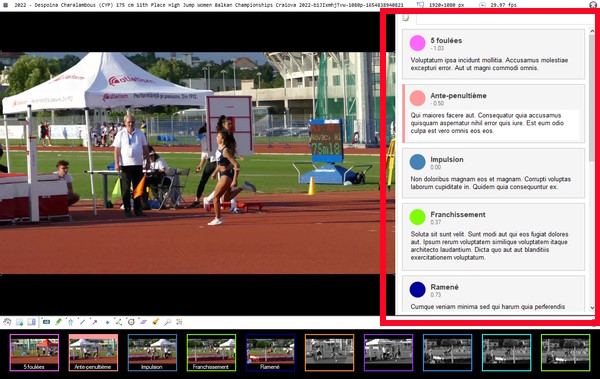
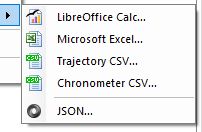
Right now it's not possible to export the comments added to key images. This is a pretty severe limitation that needs to be addressed.

It's the third or fourth time that I look into this. In an older version there was a function to export to PDF but this doesn't work, we want full flexibility in the output for the user to further edit the content, add their own logo and formatting, etc. So it should export to a Word or Writer document. The problem is that there is no lightweight library to export to these formats.

But this really needs fixing so I'm going to try a different approach. I will export to Markdown, a simple text-based format, and then I'll use Pandoc which is a separate open source software that can convert between Markdown and Word, Writer, PDF, etc.

The Pandoc binary itself is several times larger than Kinovea so I can't justify adding this directly into the program. I can see two approaches:

1. The user installs a Kinovea "plugin" that contains Pandoc and the code to call it.
2. The user installs Pandoc themselves separately and Kinovea figures out where it's installed and the code to call it is builtin.

Both require the user to install a separate thing so I might as well simplify things and just tap into an existing installation instead of wrapping a third party program into a plugin.

I haven't tried any of this yet but I'm pretty convinced the Markdown + converter makes the most sense at this point. I'm hoping this will allow the use of templates so we can generate nice reports directly.

Any thoughts or comment about this are more than welcomed.

Hi, there is a shortcut that will toggle between the delayed display and live display. In Preferences > Keyboard > CaptureScreen > ToggleDelayedDisplay. It's currently bound to ALT+Home but you can remap it to something more direct if needed.

This only changes what is shown on screen, all the mechanics for recording are kept the same, so you still use the delay amount to mean how much action from *before* the trigger will end up in the final video.

OK, I made some more tests and I like this banner thing.
Going to use it as a general visual feedback of the state of the capture screen.

Here is the current color scheme:
- audio trigger disarmed = blue (neutral state).
- audio trigger armed = green.
- during quiet period after recording = blue (+reverse progress bar until auto-rearm).
- recording = red. (+ reverse progress bar if stop after duration is enabled).
- camera grabbing on pause = violet.

This hasn't really changed but the delay at the right end of the slider depends on the memory settings in the preferences and the size and framerate of captured images. Presumably you are using a camera with higher resolution or higher framerate, hence less images fit in the allocated memory.

Looking into this right now.
First testing with a big red banner at the top to indicate that we are in fact recording. I think this needs to be super prominent because one of the use case of capture is hands free recording where you may be several meters away from the computer screen.

Now having added that, I'm wondering if this banner at the top could act as a reverse progress bar when the recording duration is pre-configured. 
Do you actually need the exact countdown in seconds or just a visual indication of the time left? Ideally I would like to just have the time since recording started written inside the banner, an the banner act as a reverse progress bar in case of countdown-based stop.

321

(1 replies, posted in Ideas and feature requests)

Yeah there is a lower limit that is enforced at the moment, it was based on having enough room for the drawing toolbars when using side-by-side comparison without the explorer panel.

As part of a future "presentation mode" I'm looking into ways to have keyboard interaction be sufficient for switching between tools and between the current tool and the hand tool. When this is implemented having the toolbar visible won't be such an important requirement to operate the program, it will be more reasonable to have a true chrome-less window at this point. I know you probably don't care about using tools at all for this use-case but I think there is a convergence between the two ideas so it will be more efficient to work on them at the same time. This won't go into the next release though, there is already too many things.

Yes, it is coming in the next version, still working on it. I already rewrote the Kinogram interaction system several times in the meantime, but it's almost done.

To draw straight vertical/horizontal lines you can hold the SHIFT key while moving the end point. In general the SHIFT modifier means some sort of constraint in the program. This works on angles and the pencil tool as well.

Thanks, that's also my preference at the moment.

Hi all,
I am considering moving to calendar versioning. So using version numbers as "2023.1" instead of x.y.z.
It seems apt considering the frequency of releases. I guess it means there might never be an official version 1.0…

There are two popular formats I would consider, YYYY.MM where the second part is the zero padded month, (ex: 2023.03) or YYYY.Minor, where the second part is the release number within that particular year (ex: 2023.1).
What do you think?

No I mean an App you download from the app store and install on the phone. Sorry I don't use an iPhone I don't really know which app is best or even if there is a free one. You need to specifically look for an MJPEG streaming server app. It will broadcast the camera to the local network, then you can connect to this server from a browser on the same network or from Kinovea.

Essentially the first step is to turn your smartphone into a network camera. On Android I use the app "IP Webcam" by by Pavel Khlebovich. To be honest I don't know if there an equivalent for iPhone, hopefully someone will come along and let us know.

You need an application that will create an MJPEG server out of the phone camera, and it is this application that should tell you the server IP and port.

327

(3 replies, posted in General)

When you save side-by-side it's going to add the widths so it won't fit into the 16:9 aspect ratio any more. I think the best approach will be to allow top-bottom saving, this will be friendlier to IG reels and YT shorts.
In the meantime you would have to externally pre-crop your videos to be 8:9 or something.

I'm doing a simplification pass and I want to get rid of this.

To explain what this is, it is a small collection of SVG files that are built into the program and exposed through dedicated menus under Tools > Observational references > … (circle, clock, foot, etc.).

These menus are simply wrappers around the creation of an SVG drawing object. To be clear, you can always use the "Import image" menu and point it to an SVG file on your system, it will do the same thing. The only thing special about these menus is that these particular SVG files are builtin. You can find the files under the "guides" folder in the program files.

The collection feels awkward. There is no clear driving logic as to what should be there, nobody is making/contributing new files and I've basically never seen a video where someone was using this feature. I feel it should be acceptable for the few that may be using this to use the import image menu instead.

This would promote the "Import image…" menu directly under tools. (maybe add this to the toolbar).
What do you think?

I am thinking of adding a "Presentation mode" with dedicated interaction mechanics for these sort of scenarios.

Here are some of the ideas, please add some more because I need to figure out if this can be implemented as a video mode similar to the new Kinogram mode, or something different.

- Adding drawings doesn't pop the keyframe area up.
- A shortcut let you delete all drawings at once.
- Scrubbing the timeline by directly dragging in the main video area, maybe CTRL+drag because otherwise it conflicts with panning during zoom.
- Pencil tool that has an arrow automatically created at the end.
- Better support for stylus interaction (Wacom graphic tablet). Currently there is a big lag during the very first stroke when it checks for "gestures", it needs to be disabled in the Wacom settings for it to work smoothly (very unhappy about this).

Basically the style of interaction I would like to optimize this mode for is the quick audio commentary (either in person or recorded by something like OBS). You move in the timeline, add a few lines/pencil strokes for illustrating what you are saying, almost immediately delete them once you made your point, move a bit more in the video, repeat.

Cadence and its derived measurements are fundamental metrics in many sports. For version 0.9.7 I want to add a Cadence tool. For the past few days I have gathered a number of ideas for user interaction and features, please add your feedback and comments.

The idea of this thread is to gather everything you can think of that may influence the design. It's a brainstorming exercise: all ideas are welcomed, we'll sort them out later.


Main use cases: Running, Swimming, Cycling, Rowing. (Add your use-case and the kind of metrics you use in the comments).

1. General interaction
- A way to add/remove a "beat" (marking the cycle). This should be a keyboard shortcut and a menu.
- A way to add/remove/update several time sections (connected or disconnected) inside which the cadence will be computed.

2. Cadence display
- count, cadence, half cadence, double cadence.
- The raw count can be interesting for example in 400 m Hurdles where we want to know how many strides are taken between each hurdle. Or simply as a repetition counter for any sort of exercises.
- half cadence and double cadence: for example in swimming it's easier to mark the beat when a specific arm goes down into the water but we may want to know the stroke rate instead. In running it's easier to tap a beat on each step but we might be interested in a tempo based on the full cycle.
- Precision: integer cycles or fractional cycles. (70 rpm vs 70.512 rpm). Fractional raw count may be interesting as well.

Question
- Do you think the simple counter and the cadence tool should be two different tools? It seems a bit convoluted to use a cadence tool if all you want is to quickly count reps.

3. Partial cycles in a given period
- I'm thinking the "beats" should be recorded independently of the time sections, as they may not always align.
- This means we can have partial cycles at the begining and the end of the time section.
- For the "raw count" display we'll need to know if these should be included in the count.
- For calculating the cadence we can probably always use the whole cycles in the period and divide by the time span they cover, it will be more precise than trying to guess the fraction of cycle at the corners.

4. Compute period
- The basic idea is thus to compute cadence by averaging over the time section (full cycles divided by their span).
- Another idea would be to compute the cadence based on the last X seconds or the last X cycles. How useful is this?

5. Distance calibration
- If we know the distance covered during the time period we can compute extra metrics.
- Stride or stroke length.
- Pace (time per distance unit).
- So it should be possible to go and specify the distance coordinate of time section end points.
- However, this calibration is going to be over the whole time section, so now we definitely need to to deal with the partial cycles at the start and end of the section.

6. Units
- Each sport uses a different cycle name and time span for their canonical "frequency". Step, stride, stroke, revolution, rotation… per minute, per second.
- I guess the default unit should probably be "Hertz" to stay neutral and SI.
- Then it would be nice to be able to configure the actual unit name you are interested in computing/displaying.
- Should this be configurable per object or in the global preferences like speed/acceleration units?

7. Cadence deviation
- It could be interesting to be able to set a reference cadence and then have the tool show how much the measured cadence deviates from that reference.
- Possible measures for deviation: raw time delta compared to the expected beat, fraction of cycle.
- Actually this deviation doesn't even need a reference, we could compute the average cadence and display the deviation at the current position compared to that running average.


https://www.kinovea.org/screencaps/0.9.7/metronome.png Cadence

https://www.kinovea.org/screencaps/0.9.7/counter.png Counter


That's all I can think of for now. Please add more ideas and comments below, so we can have a good overview.